
Language Matters: How Communication Shapes Attitudes to Gender Equality
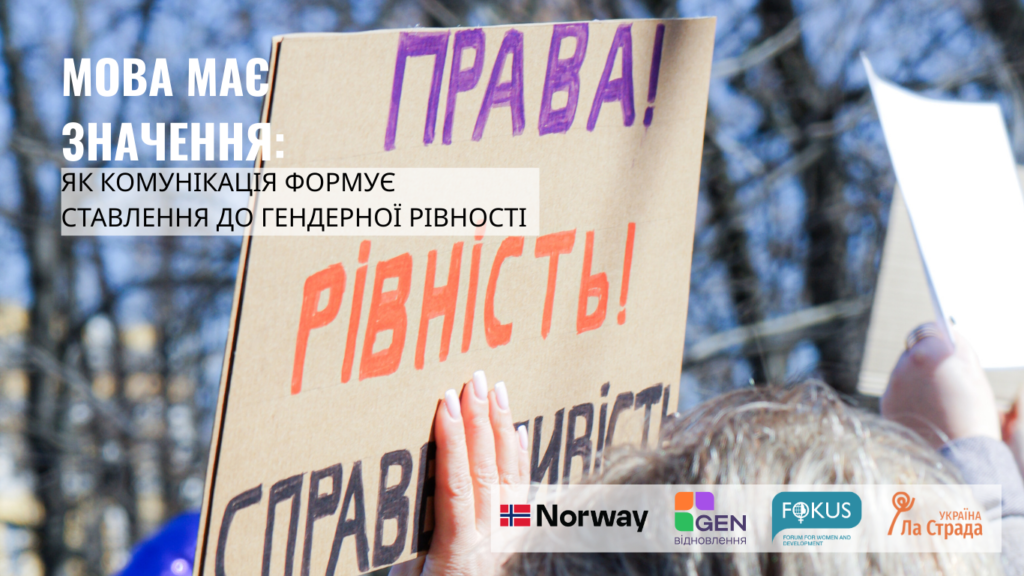
We rarely think about the words we use every day. They seem familiar, neutral, and simply convey information. But in fact, language is not just a tool for communication. It shapes our perception of the world, of the roles of women and men.
When we only hear in the news "director", "minister", "military", then we subconsciously imagine a man. When the words appear "director", "minister", "military woman", the picture becomes more complete – it begins to reflect a reality in which women also hold these positions, take on responsibility, and make decisions.
That is why it is important to talk about gender-sensitive language. Not in order to "complicate" speech or create new rules for the sake of rules. But in order to make visible those who have not been named for years. So that words correspond to reality. So that communication does not support stereotypes, but promotes equality.
In the Ukrainian context, this question has an even deeper meaning: we are rethinking our own identity and values. And language is one of the key tools of these changes. It either reinforces old ideas about “feminine” and “masculine” roles, or helps to revise them.
So talking about gender-sensitive language is not just a conversation about linguistics. It's a conversation about respect, justice, and equal opportunity.
The use of gender-sensitive language consists not only in the correct use of gender terminology in accordance with generally defined and unified definitions, but also in the use of feminine pronouns and the avoidance of sexism, which leads to the formation of a gender-sensitive discourse as a whole.
The public is moving towards the general use of feminines and often brings this issue up for discussion both in wide circles and personally. Meanwhile, the National Commission on State Language Standards notes: "Ukrainian spelling does not require the mandatory formation of nouns to designate female persons. Ukrainian spelling in part 4 of paragraph 32 only lists the suffixes that can participate in the formation of such nouns"
The need to form such a discourse is not only a Ukrainian problem – it also exists in other countries with different language systems. That is why it is manifested at the level of international organizations, in particular The United Nations and the Council of Europe, who develop recommendations for non-discriminatory communication.
Why is gender-sensitive language important?
- This is a manifestation of justice and respect.
By naming a person according to their identity – using, for example, feminine terms like “director,” “teacher,” “soldier” – we acknowledge their professional and social subjectivity. The name and form of address matter: they either confirm the person’s presence or devalue their role. - This is a tool for implementing the principle of gender equality.
Gender equality is not only about the formal consolidation of rights, but also about the real conditions for their implementation. Language shapes the public perception of who can be a leader, a scientist, a soldier or a politician. If women are linguistically invisible in the public space, this also affects the perception of their opportunities. - This is a way of avoiding stereotypes.
Traditional language constructs often reproduce outdated notions of “feminine” and “masculine” roles. Gender-sensitive language avoids wording that automatically associates certain occupations or characteristics with only one gender. - It is a means of visualizing women in public life.
This is especially important in areas where women have historically been underrepresented, such as the security and defense sector. When the words "female officer," "female sniper," and "female unit commander" appear in the information space, this is not just a linguistic innovation - it is a reflection of the real participation of women in processes. - This is the direction of development of the modern Ukrainian language.
The emergence of new lexemes – primarily feminines – is evidence of social changes. Language responds to transformations in society, and its development is a natural process. The modern Ukrainian language demonstrates the ability to flexibly reflect new realities and social roles. - This is a marker of value choice.
In the context of a full-scale war, the issue of language takes on additional symbolic significance. In Russia, the use of feminines in the Russian language is officially recognized as a manifestation of “extremism,” which indicates the ideological nature of language policy. In contrast, for Ukraine, gender-sensitive language is part of the democratic and human rights-based course of the state, emphasizing the difference in values and social orientations. - This is a tool for gender-sensitive communications.
Communication between government agencies, media, NGOs, and educational institutions shapes social norms. When gender-sensitive language is used in official communications, documents, and news, it gradually establishes new standards of mutual respect and inclusion. - This is a tool to combat sexism and discrimination.
Sexism is often disguised as “common language” or “tradition.” However, it is through everyday language practices that inequality is reproduced. The conscious use of gender-sensitive language reduces the risk of humiliation, stereotyping, and exclusion.
Language as a space for change
Communication is not neutral. It either supports existing hierarchies or contributes to their revision. When we change words, we gradually change the framework of thinking.
Gender-sensitive language is not about “fashion” or “formality.” It is about creating a space in which every person is visible, recognized, and equal in their dignity.
At first, the use of feminines may seem unusual and make you think about how to say it correctly. However, language is a social phenomenon, and like any social phenomenon, it is constantly developing, updating, and modernizing. What seemed to be an unchanging canon yesterday, today easily takes on new forms.
In short, language is important not only as a means of transmitting information, but also as a mechanism for shaping social norms and values. And it is the words we choose today that determine what our society will be like tomorrow.
This article was made possible by the support of the Norwegian people through the Ministry of Foreign Affairs of Norway (MFA of Norway) within the framework of the project “Building a Gender-Inclusive Recovery with the Women’s Movement of Ukraine” (GEN-Recovery). Responsibility for the content of the information lies with the NGO “La Strada-Ukraine”. The information presented in this article does not necessarily reflect the views of the Ministry of Foreign Affairs of Norway or the Government of Norway.
 Українська