
The Gender Pay Gap: Why It Matters and How to Close the Inequality
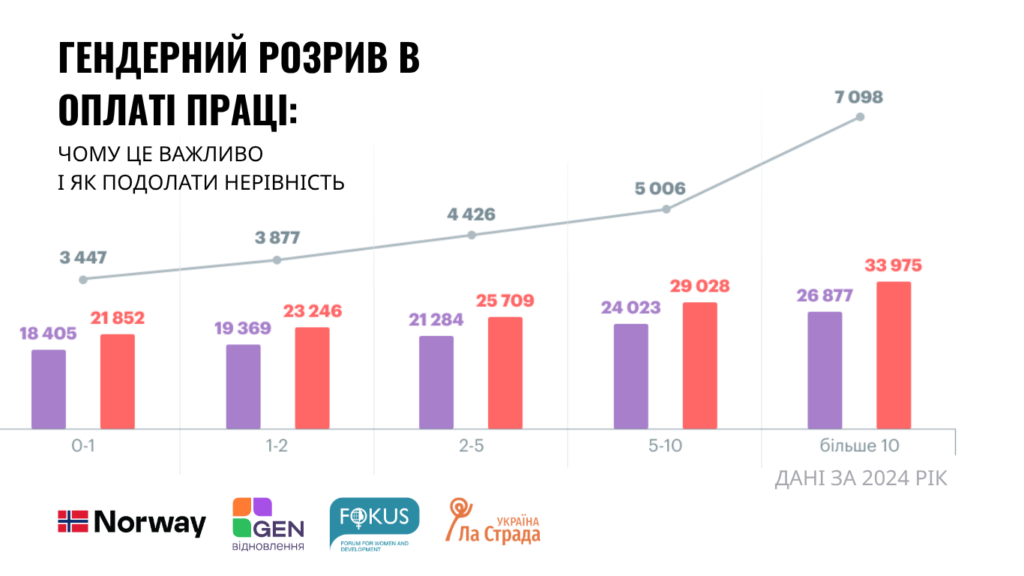
Salary gap by gender and years of experience by 2024 – source budni.robota.ua
The gender pay gap is one of the most visible forms of economic inequality. It affects not only wages today, but also pensions, economic independence, career development and the quality of life of people throughout their working lives. Despite the existence of laws that guarantee equal rights and opportunities, the real situation shows that gender discrimination is still far from being overcome.
What is the gender pay gap?
The gender pay gap is the difference between the average earnings of women and men. In most countries of the world, including Ukraine, women earn less than men for similar work or work of equal value. In Ukraine, the pay gap is about 18,6 % (i.e. women earn almost a fifth less than men), even when they have similar qualifications and working conditions.
This is not just a statistical figure – it is real money that women are underpaid each year, and later underpaid in the form of pensions or social guarantees. Such inequality accumulates over the years and affects the financial independence of each person.
The main reasons for the breakup
The gender pay gap has complex causes:
- Stereotypes and traditional roles.
Popular ideas about "male" and "female" professions in society lead to women more often working in lower-paid fields or choosing part-time employment to combine professional activities with family responsibilities. - Uneven distribution of unpaid work.
Women are more likely than men to perform unpaid domestic work – running the household, caring for children or relatives. This affects their access to full-time employment and career advancement. - Restrictions on the choice of professions and positions.
Some of the highest-paying professions and management positions have historically been dominated by men. In addition, labor laws still restrict women from working in certain conditions, which automatically reduces their access to some jobs.
Consequences for society
The gender pay gap is not just a problem for women. It has serious consequences for the entire economy and society:
- Economic loss of potential: Women who work for lower wages have fewer opportunities to invest in education, professional development, or entrepreneurship.
- Pension inequality: Lower earnings today mean lower pensions tomorrow, which is especially important for a generation of older women.
- Family economics: When women earn less, the family has fewer resources to provide for needs, children's education, medical care, etc.
This is not an abstract gender indicator - it is a matter of the well-being of entire families and the sustainability of the economy.
Issues in Ukraine today
The Ukrainian government recognizes the problem and is already working to address it. National strategies have been adopted to reduce the pay gap. The goal is to reduce this figure from 18.6 % to approximately 13.6 % by 2030. This should be facilitated by modernizing labor legislation, ensuring equal rights to flexible forms of work, as well as campaigns to support women's professional development.
Information campaigns that try to change public perceptions about careers, paid work, and women's professional ambitions also play an important role.
How can we promote change?
Bridging the gender gap is not just a matter for the state or individual organizations. It concerns each of us:
- awareness of one's own prejudices,
- supporting equal pay policies in organizations and companies,
- transparency of salaries and job evaluation standards,
- encouraging equal sharing of household and family responsibilities,
- investments in the professional development of all employees without gender bias.
The gender pay gap is a systemic problem that affects the economic stability, career opportunities, and living standards of millions of people. It is not just women who are interested in closing it – society as a whole benefits when everyone is fairly compensated for their work.
Equal pay is a fundamental value of a fair and efficient society that values talent and work regardless of gender.
This article was made possible by the support of the Norwegian people through the Ministry of Foreign Affairs of Norway (MFA of Norway) within the framework of the project “Building a Gender-Inclusive Recovery with the Women’s Movement of Ukraine” (GEN-Recovery). Responsibility for the content of the information lies with the NGO “La Strada-Ukraine”. The information presented in this article does not necessarily reflect the views of the Ministry of Foreign Affairs of Norway or the Government of Norway.
 Українська