
The story of the Mirabelle sisters and the 16 Days of Activism against Gender-Based Violence campaign
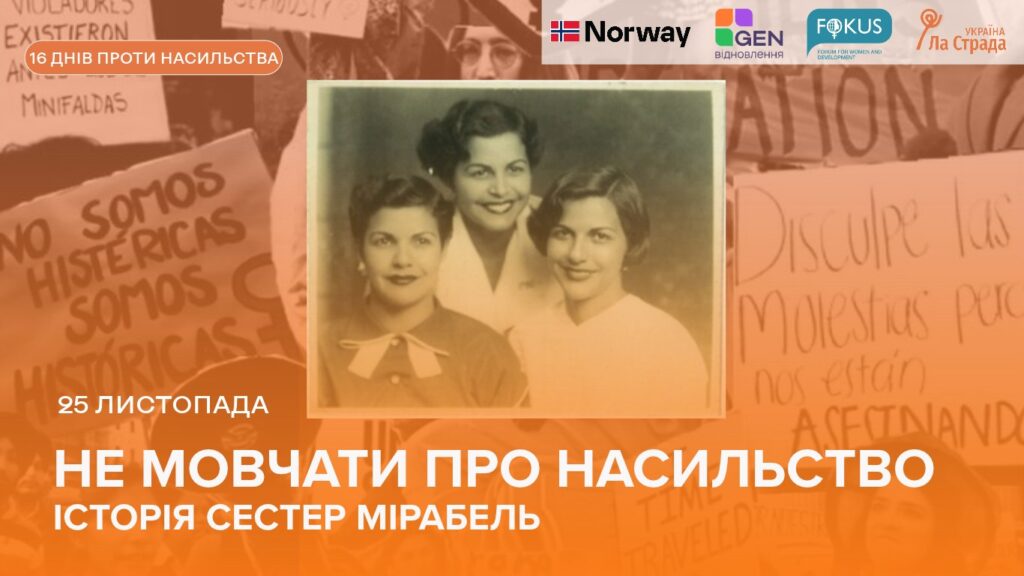
Every year on November 25, the international campaign "16 Days of Activism against Gender-Based Violence" begins, which aims to draw attention to the problem of violence.
The Mirabelle Sisters: The Story That Begins on November 25
Patricia, Minerva, and María Teresa Mirabel were Dominican activists who opposed the dictatorship of Rafael Trujillo in the Dominican Republic. The country was ruled by an authoritarian regime characterized by political persecution, repression, and restrictions on civil liberties.
The sisters participated in the opposition movement, spoke out against the dictatorship, and were persecuted by the authorities. Because of their activities, they were repeatedly threatened, but they continued to fight.
On November 25, 1960, three sisters were murdered by order of the regime. Their deaths caused a public outcry and later became a symbol of resistance to violence and the fight for human rights.
In 1981, participants in the First Meeting of Latin American Feminists proposed celebrating November 25 as the day to combat violence against women. And in 1999, the UN General Assembly officially proclaimed this date as the International Day for the Elimination of Violence against Women.
What forms of violence are important to recognize?
One of the important goals of the 16 Days of Activism Against Gender-Based Violence campaign is to help people recognize different forms of violence and not accept dangerous behavior as the norm. After all, violence is not always accompanied by physical harm. It can manifest itself through words, threats, control, restriction of freedom, and financial dependence.
In particular, it is important to distinguish between the following forms of violence:
– Physical violence — slapping, hitting, pushing, beating, deprivation of liberty, preventing exit from the premises, and other actions that cause physical pain or harm to health.
– Psychological violence — humiliation, insults, threats, intimidation, blackmail, isolation from loved ones, constant criticism, control of communication and behavior.
– Sexual violence — any acts of a sexual nature without the voluntary consent of a person, coercion to engage in sexual contact, unwanted touching, sexual harassment, and coercion to view materials of a sexual nature.
– Economic violence — restriction of access to money, prohibition of work or study, deprivation of housing, documents or property, control of expenses and creation of financial dependence.
– Digital violence — online harassment, hacking of personal accounts, geolocation tracking, monitoring of correspondence, threats to distribute private photos or videos, publication of personal information without consent.
These forms of violence can be combined and repeated. For example, a person who controls their partner's finances may simultaneously restrict communication with loved ones, threaten and humiliate them. Therefore, it is important to pay attention not only to individual actions, but also to the general pattern of behavior aimed at controlling and limiting the freedom of another person.
Why is it important not to shift responsibility onto the victims?
Questions like “Why didn’t she leave?”, “What did she do wrong?”, or “Why didn’t she get help sooner?” shift the focus from the abuser’s behavior to the victim’s actions.
The decision to stay in a relationship, not report the abuse, or delay seeking help may be due to fear, threats, financial dependency, the presence of children, lack of a safe place, or other circumstances.
Responsibility for violence always lies with the person who commits it. Victims do not have to prove that they have suffered enough to be entitled to support and protection.
If you have been a victim of domestic violence or gender discrimination, please contact the National Hotline for Prevention of Domestic Violence, Human Trafficking and Gender Discrimination for advice and assistance:
📱116 123
☎ 0 800 500 335
Telegram: https://t.me/NHL116123_bot
Instagram: https://www.instagram.com/lastradaukraine?igsh=anhubWR2YzZvZWxj
Facebook: https://www.facebook.com/share/1DDns7NTvT/?mibextid=wwXIfr
This article was made possible by the support of the Norwegian people through the Ministry of Foreign Affairs of Norway (MFA of Norway) within the framework of the project “Building a Gender-Inclusive Recovery with the Women’s Movement of Ukraine” (GEN-Recovery). Responsibility for the content of the information lies with the NGO “La Strada-Ukraine”. The information presented in this article does not necessarily reflect the views of the Ministry of Foreign Affairs of Norway or the Government of Norway.
 Українська