
Science is changing the world – from medicine to artificial intelligence, from sustainability to digital technologies. And these changes must be inclusive and accessible to all. Yet, despite advances in education and rights, women and girls remain underrepresented in scientific and technical fields.
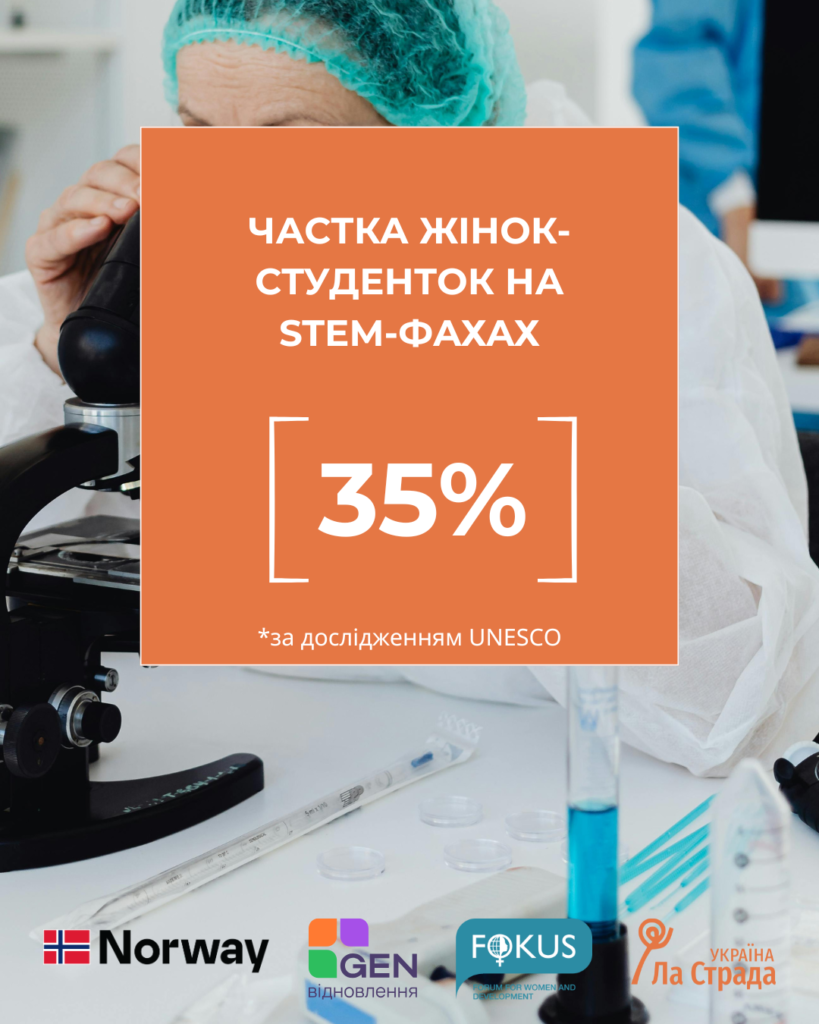
UNESCO claims: The proportion of women studying STEM subjects – science, technology, engineering and mathematics – is only 351%. These are not just numbers: they are important to recognize in order to move closer to gender equality, so as not to lose potential when talented girls and women are unable to realize their abilities in science.
The problem has several levels:
- Gender stereotypes – in many societies, there is still a belief that complex sciences are “not for girls.” Such attitudes are formed at an early age when parents, teachers, or the environment do not support a girl’s interest in mathematics or physics.
- Lack of role models: If a girl doesn't see women scientists in the profession, it's easier for her to imagine herself as someone other than a scientist or engineer. The visibility of successful women in science is a powerful motivator.
- Discrimination and the “Matilda Effect” – a sexist bias towards recognizing the achievements of female researchers, whose work is often attributed to their male colleagues.
Various studies prove that teams with an equal representation of women and men have higher creativity, productivity, and innovation.
Today we would like to talk about our female scientists who shared experiences that reveal real barriers to scientific achievement and at the same time demonstrate the power of perseverance.
The balance between science and life: a challenge to reality
Finding a balance between professional fulfillment and personal life remains one of the most pressing issues for female scientists. In the context of a full-scale invasion, this task becomes critical.
In our realities, combining work, graduate school, research, and life outside of them is a real challenge. Turning off the lights, constant shelling, raising a small child, trying to find time for family and at least a little for yourself. All this sometimes covers a wave of anxiety, panic, and exhaustion. But over time, I realized that balance is not about a perfect schedule, but about being honest with yourself, – Valeria shares.
Tatyana told about his experience of entering graduate school and writing a dissertation, which fell on the craziest period in the lives of thousands of Ukrainians:
Covid, full-scale war, husband's mobilization, pregnancy, birth of daughter. At the moment when the veil was on, of course I felt the imposter syndrome.
Impostor syndrome
Impostor syndrome – a psychological phenomenon in which successful people fail to acknowledge their own achievements, attributing their success to luck rather than talent or hard work – especially common among women in science.
Tatyana recalls:
I felt like I wasn't doing enough, I wasn't keeping up, others were doing better. The turning point came when I realized that science is not a sterile space outside of life, but that it is my life.
However, not all scientists face this phenomenon in the same way. Olga notes:
I don't suffer from imposter syndrome, it was more difficult to find the time and, most importantly, the resources to research and write a dissertation.
At the same time, women researchers often face the need to justify the relevance of their topics, especially when they relate to gender issues.
I was very lucky with my supervisor, so we agreed on the gender topic without any problems. It was more difficult to tell the uninitiated what I was writing about and to explain that gender issues, philology, disinformation, and manipulation all go together in a quality study, – Olga says.
The power of a female perspective in science
Despite numerous obstacles, women bring unique value to science.
Valeria is convinced:
Women in science often have a special sensitivity to people, contexts, and details. They are people who can listen, notice the invisible, ask deep questions, and seek not only the right but also the human answers.
Tatyana emphasizes:
For me, women in science is not about ideal conditions and harmonious harmony, but a story about endurance, discipline, and a woman's right not to give up even when life demands the impossible."
Advice for future researchers
Our colleagues urge women not to give up on a scientific career, despite the difficulties.
It is very important to have an internal answer to the question: why do you need this path? When there is a conscious goal, graduate school ceases to be just a difficult test and becomes a space for the implementation of your own ideas, research, and professional growth.”, – Valeria advises.
Tatyana puts it bluntly:
Science needs women's voices, women's topics, women's leadership. It's important for us to be visible, to take on leadership roles, to shape the agenda, not just fit into it.
Olga adds:
I would advise you to go! After all, if you don't write it, who else will?
The experience of Ukrainian female scientists demonstrates that gender barriers in science exist not as abstract concepts, but as an everyday reality: This is the need to justify the relevance of one's topics, to fight the imposter syndrome, to combine professional ambitions with family responsibilities in conditions of war and instability.
What can we do today?
- Support girls who are interested in science or technology.
- Demonstrate positive examples of women scientists.
- Talk about gender equality openly – at school, at university, at work.
- To create a safe and comfortable environment where everyone can realize their potential without fear of judgment or discrimination.
Women belong in science as much as in any other area of life. Support, equal opportunities, and the realization that no stereotypes can determine professional choices are the keys to real progress.
This publication was made possible by the support of the Norwegian people through the Norwegian Development Agency (Norad). Responsibility for the content of the information lies with the NGO “La Strada-Ukraine”. The information presented does not necessarily reflect the views of the Norwegian Development Agency or the Government of Norway.
 Українська