
Motherhood during war: between care, exhaustion and societal expectations
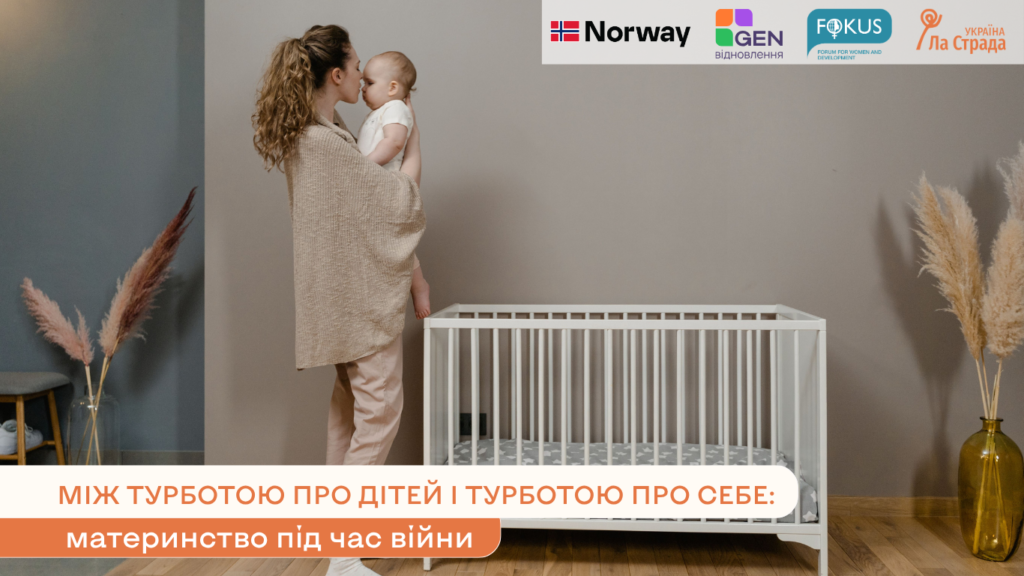
Motherhood during war is daily care for a child in conditions of uncertainty, when even routine tasks require more time, energy, and internal resources. How to calm a child when she is scared herself? How to combine work with care if the kindergarten is closed due to air raids and learning is done remotely? How to support a child when one's own experiences are ignored?
Added to these challenges is the societal expectation that a mother must be able to handle everything. To be patient, attentive, caring, find the right words, provide a sense of security for her child while simultaneously working, maintaining a household, and coping with her own emotions. Even in the most difficult circumstances, women are often expected to remain strong and not show fatigue.
Caring for children is not just a woman's responsibility
There is still a widespread perception in society that women should be responsible for raising children, their education, emotional well-being, and daily needs. Even when both parents work, much of the organizational and emotional work may fall on the mother.
During war, this burden often increases. It is necessary to monitor security, organize training, respond to alarms, and find ways to support the child after experiencing stress.
Parenthood involves shared responsibility for the upbringing, living, decision-making, and supporting the emotional well-being of a child — to the extent possible in the specific circumstances.
Social expectations and feelings of guilt
Real difficulties are often compounded by assessments and comments from those around them. A woman who works a lot may hear that she is not paying enough attention to her child. A woman who has temporarily left her job to care for her child may hear that she is losing professional opportunities. A woman who is left alone with her children may be asked why she did not organize her life differently.
Such assessments often do not take into account the circumstances of the war, the resources available to the family, or the woman's personal circumstances. They create a situation in which any decision can be subject to criticism.
As a result, a woman may feel guilty for working, getting tired, not having enough time for her child. Sometimes even a short vacation is accompanied by the thought that this time should be devoted to the family.
However, guilt does not always indicate that a woman is actually doing something wrong. It can also arise from inflated expectations - both their own and those imposed by others.
Exhaustion doesn't mean you're a bad mother.
Constant stress, lack of sleep, anxiety about loved ones, everyday difficulties, and the need to make decisions under uncertainty can be physically and emotionally draining.
At such moments, you may lack patience, find it difficult to concentrate, become irritable, or want to be alone. Sometimes it seems that you don't have enough energy even for the usual things.
It's important to remember: you may love your child and yet be exhausted from the daily grind. You may long to spend more time with them but need a break. You may not know all the answers and may not always find the right words.
Motherhood does not deprive you of your own feelings, needs, and personal life. You remain a human being who also needs security, support, connection, recovery, and the opportunity to fulfill yourself outside of your parenting role.
It is important for a child to have an adult who cares for them. However, this does not mean that a mother should always be available, hide her emotions, or sacrifice all of her own needs.
What can be done?
To reduce your workload, it's important not to try to do everything yourself. When possible, share responsibilities with loved ones, ask for specific help, and find time to rest. Not everything needs to be done at once, and procrastinating doesn't make you worse off.
It's also important not to ignore your own feelings. You may be tired, anxious, irritable, or insecure—and that doesn't mean you don't love your child enough. If your feelings become too strong, don't hesitate to seek psychological support.
If you have suffered from domestic violence or gender discrimination, need advice or don't know where to turn for help, call National hotline for the prevention of domestic violence, human trafficking and gender-based violence
If you have been a victim of domestic violence or gender discrimination, please contact the National Hotline for Prevention of Domestic Violence, Human Trafficking and Gender Discrimination for advice and assistance:
📱116 123
☎ 0 800 500 335
Telegram: https://t.me/NHL116123_bot
Instagram: https://www.instagram.com/lastradaukraine?igsh=anhubWR2YzZvZWxj
Facebook: https://www.facebook.com/share/1DDns7NTvT/?mibextid=wwXIfr
This article was made possible by the support of the Norwegian people through the Ministry of Foreign Affairs of Norway (MFA of Norway) within the framework of the project “Building a Gender-Inclusive Recovery with the Women’s Movement of Ukraine” (GEN-Recovery). Responsibility for the content of the information lies with the NGO “La Strada-Ukraine”. The information presented in this article does not necessarily reflect the views of the Ministry of Foreign Affairs of Norway or the Government of Norway.
#LaStrada #LaStradaUkraine #LaStrada #LaStradaUkraine#Focus #FocusUkraine
 Українська